It is widely held that perhaps the greatest mind in history, or at least in the Catholic Church, was Saint Thomas Aquinas. St. Thomas began his formal education at the age of Five. Five!! At that age I was being escorted under extreme duress to the gates of the Catholic school where I was to begin kindergarten. Why under duress? Because, frankly, I wanted to stay with my Mommy! Plus those ladies in the black dresses looked very mean…and some turned out to be just that. But I digress. Thomas trained with the Benedictine monks at the Abbey of Monte Cristo beginning at the age of five and continuing until he was thirteen. From age thirteen to eighteen he studied Aristotle. I was studying the girls from the all-girls Catholic School as they got on the city bus. Needless to say, I was never going to make saint in this life. Saint Thomas went on to writing about the fusion of Philosophy and Theology, making the claim that they were not exclusive concepts.
Thomas famously wrote five points proving the existence of God:
1) observing movement in the world as proof of God, the “Immovable Mover”; 2) observing cause and effect and identifying God as the cause of everything; 3) concluding that the impermanent nature of beings proves the existence of a necessary being, God, who originates only from within himself; 4) noticing varying levels of human perfection and determining that a supreme, perfect being must therefore exist; and 5) knowing that natural beings could not have intelligence without it being granted to them it by God.
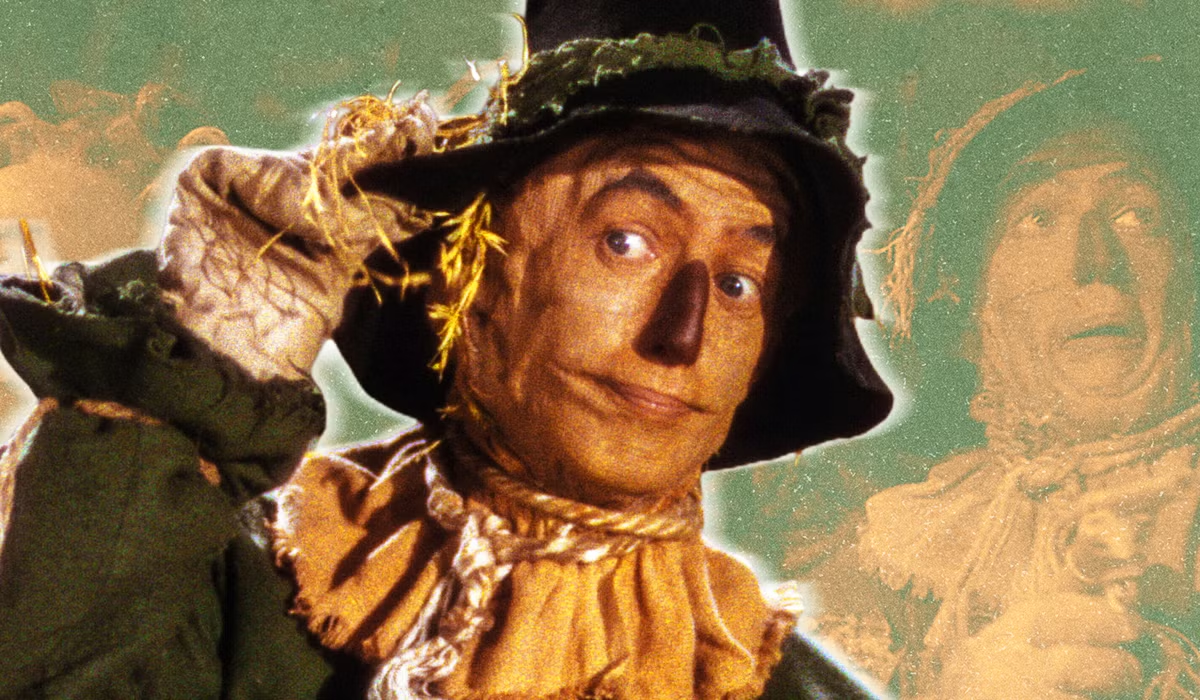
He then spent much of his life writing the treatise, Summa Theologica His masterwork encompassing a massive, highly organized summary of the entirety of Catholic theology that addresses thousands of questions concerning God, ethics, and humanity using rigorous logical structuring. The thing is, he only completed 80% of the work. Why? One day while celebrating Mass he received a vision that some believed was a view of eternity. He went into a prolonged trance during the service. Friends and colleagues say that, from that point on, he was a different man. He ceased all work on Summa, despite his secretary begging him to finish. His response to that request was his famous line, “I can write no more. All that I have written seems to me like straw compared with what has now been revealed to me.” Straw! Perhaps the greatest text in Catholic history was described by its author as straw.
St. Thomas Aquinas apparently saw what the author of Ecclesiastes, also know as Qoheleth (The Teacher),also perceived. That when held up against what God has planned for us in eternity, this life pales in comparison. Even a life as esteemed and accomplished as St. Thomas. In the first reading from Ecclesiastes, Qoheleth (some believe him to be King Solomon), gives numerous descriptions of the decay of our bodies as we age. He compares this to life as a younger person. And he advises us to enjoy the life God gave us while we can. Before the aforementioned decay sets in. He does not mean to throw caution to the wind and suggest we start sinning as fast as we can. He stresses to live the life God gave you but not to forget who the Creator is. To keep your eyes focused on the Lord using His gifts to their fullest. But the end comes to all of us and there is a need to keep it all in perspective.
While Thomas compared the folly of life to straw, Qoheleth uses the line that has become a signature for the book of Ecclesiastes:
Vanity of vanities, says Qoheleth,
all things are vanity!
In this case, vanity does not mean being vain or prideful. It is based on the Hebrew word which means fleeting or fragile. We can be the greatest thinker in history. The greatest actor or actress. The most remembered athlete. But, in the end, there is only one thing that matters. Did your life put you on a path that leads to an eternal life with God. All else is straw.