What do Shia LeBeouf, Russell Brand, Candace Owens and John Wayne have in common? All, along with many non-celebrities, converted to Catholicism later in life. Why? What drew so many persons to pivot from atheism, Protestantism, being agnostic or just not interested in organized religion? Many would say that if you do not want to be part of an organized religion, choose Catholicism. We have always been anything but organized! In reality there are likely as many reasons and stories for becoming Catholic as there are people who have converted.
Some are attracted by the history of the Church. That it is the Church that Christ founded. Some like the fact that Catholic teaching and beliefs have changed little in over 2,000 years. What was true in Jesus’ time is still true today. For some, it is the Eucharist. The real presence of Jesus in the bread and the wine. Something only the Catholic Church professes. That the bread becomes Jesus’ body, and the wine His blood, completely and totally. Finally, there are those that are attracted by the traditions and rituals that are so much part of the faith. Especially, if attending the Traditional Latin Mass. We have the seven sacraments. The use of holy water in blessings. Ash Wednesday reminds us of our birth and our death. We pray the rosary to help us learn and remember the key moments of Christs life. We have Eucharistic Adoration and the many shrines commemorating Mary’s appearances to us and communication with us. We genuflect to show respect and we make the sign of the cross in order to remind us of God’s three natures.
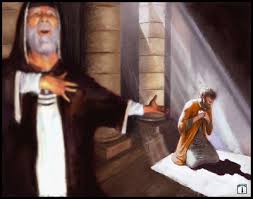
In the Gospel today, we have the familiar story of the Pharisee and the Tax Collector. We see the Pharisee, a respected leader in the Jewish community, standing in the temple, making sure God knows all that he has done to praise and worship the Lord. As if God was not already aware of everything each one of us does. But he wants to be sure that God knows that he fasts weekly and pays tithe on all his income. Also that he is not greedy, adulterous and dishonest as is the tax collector. He is proud of who he is and is sure God has taken notice as well. Not like the sinful tax collector. Someone who extorts other Jews and steals from them by imposing excessive taxes.
But what does the tax collector have that the Pharisee does not? Humility. While the Pharisee publicly announces his many instances of following the Law, the Tax Collector merely bows his head and asks God for His forgiveness for his many sins. He is not even able to raise his eyes in worship to God. He expresses profound humility. The Pharisee? The definition of self-righteousness. A contempt for others while relying on his own merits. Leaving no room for God to work in his life. Surely, we are not like the Pharisees….or are we? We go to Mass weekly, sometimes, during the week, We receive the Eucharist but are sure to confess any serious sins in confession. We spend one hour per month in adoration chapel. We put our offerings in the appropriate envelopes…ensuring that we get credit for the charitable contribution. We fast on Ash Wednesday and Good Friday and we abstain from meat on Fridays during Lent.
Check, check and check. Good to go.
Sound familiar? Sounds a lot like what the Pharisee proclaims while standing in the temple:
The Pharisee took up his position and spoke this prayer to himself,
‘O God, I thank you that I am not like the rest of humanity —
greedy, dishonest, adulterous — or even like this tax collector.
I fast twice a week, and I pay tithes on my whole income.’
Now no one would say that our adherence to the rituals and traditions of the faith are bad. Just as, at face value, what the Pharisee is proclaiming is offending God. Hardly. These actions are rooted in what God asks of us in the Scriptures. But how do we approach God with what we do in His name? Jesus addresses this in Luke:
“So likewise ye, when ye shall have done all those things which are commanded you, say, We are unprofitable servants: we have done that which was our duty to do” (Luke 17:10)
God expects us to behave as the unprofitable servant. We do what it is our duty to do. And, therefore, we cannot compare ourselves to others and profess our virtues to God. And God asks that we exercise humility. As someone who recognizes his sinfulness and limitations. That does not approach God with pride as if these works are what bring us to eternal salvation. It is, in fact, a gift from God that we either accept or reject. But it is God who approaches us first. Not because we are better than others. But because we are one of His children and He wishes that we spend eternity with Him. But we are sinful by our nature. How can we deserve this gift from God? We cannot. But that fact merely confirms God’s mercy and forgiveness. And love for us.
So while it is exciting to see so many people, particularly famous people, choosing to join the Church, it is important that we recognize the gift that God has given us. Not the stained glass windows, or large crucifix hanging above the altar. Not the incense or Holy Water. Not even the Eucharist. No. While these things are helpful in focusing us on God, the real truth and beauty of our faith is knowing this one gift that means it all….That “while we were still sinners, Christ died for us” (Romans 5:8)
