My wife, Elise, is a saint. I have a temper. It was much worse when I was younger but it still rears its ugly head every now and again. And, as those who share my tendency know, we often direct our outbursts at those closest to us. Many times our spouses bear the brunt of it all. I have never physically abused Elise but I have hit her with a barrage of emotional outbursts many, many times. I recall when I did poorly on a Clinical Pathology exam in veterinary school I went home and cut the grass. All the while my anger over my poor performance building up inside. Elise tried to comfort me saying things like, “it is just one exam” or “you will do better on the next one”. My response was to get off the lawn tractor, turn it upside down (don’t be impressed…it was a small one) and punch, yes punch, it. I have put holes in drywall and broke my hand punching a doorway after a town meeting that didn’t go as I wanted it to go.
Through all of this Elise has stood by me. Not happy with me, of course. But she stayed with me. And we have had an amazing life. None of which would have been possible without her being there. Radical Mercy. Forgiveness that goes above and beyond what many may expect. We see it in a few places, including in Scripture and in the lives of the saints.
Mehmet Ali Ağca. Some know him but many do not. In 1981 Ağca was in St. Peter Square when Pope John Paul II was traveling in his open car amongst the throngs of people hoping to get a glimpse of him. At 5:17 PM Rome time, Ağca opened fire striking the Pope in the chest and finger resulting in life threatening injuries. He required 5 hours worth of surgery to remove the bullet and stop the bleeding. In the end, he pulled through. Two years later, John Paul visited Ağca in his cell and forgave him for almost killing him. The Pope convinced the Italian authorities to drop the charges against Ağca and he was extradited to his home country of Turkey. Years later he went to the Pope’s burial spot. Laying white roses on his grave.
Maria Goretti was 12 years old and helping to take care of the family’s home during the day while her parents were working the fields. Alessandro Serenellis, the 20 year old next door neighbor, came to Maria and wanted to have relations with her. She refused, warning Alessandro that he would go to hell for this behavior. He continued his advances and when she continued her refusal he stabbed her 14 times. Maria died of her wounds a few days later. Maria appeared to Allesandro in prison where she forgave him in a dream. When he was released from prison, Allesandro attended Maria’s canonization ceremony.
In today’s first reading we hear of the death of Jacob and his burial alongside Sarah in the field that Abraham had purchased from the Hittites for use as a family plot. Eleven of Jacob’s sons, all but Joseph, confer following their Father’s death regarding what may become of them without Jacob’s presence. Will Joseph take revenge on them because of their selling him off as a slave and faking his death. So they approach Joseph and tell them that their Father, before he died, told them to beg for Joseph’s forgiveness. They also threw themselves down before their brother asking him to make them his slaves. Joseph had the opportunity, with their Father gone, to take revenge on his brothers for their actions against him. Joseph instead responded to his brothers in this way:
“Have no fear. Can I take the place of God?
Even though you meant harm to me, God meant it for good,
to achieve his present end, the survival of many people.
Therefore have no fear.
I will provide for you and for your children.”
Jesus hung on the cross facing those who had just condemned and crucified Him and spoke these words:
“Father forgive them, for they know not what they do”
To the thief who asked Jesus to remember him when Jesus came into His kingdom, He replies:
“Truly, I say to you, today you will be with me in Paradise.”
In the film, Schindler’s List, Liam Neeson plays Oscar Schindler, a German Industrialist during World War II. Schindler is friendly with the Germans and able to freely interact and have some influence with many of the officers. It became known after the war that Schindler had saved the lives of thousands of Jews at the Plaszow concentration camp near Krakow by employing them at his munitions factory. In one scene from the movie, Schindler is talking to the camp commander, Amon Goeth, about what real power is. Goeth would routinely murder inmates at the camp indiscriminately, at times shooting them as if for sport from the window of his villa. Schindler tells Goeth that real power is when we have every justification to kill, but we do not. When a man appears before an emperor and begs for mercy knowing he is going to die. And the emperor pardon him. A worthless man and he lets him go. THAT is power, Schindler says.
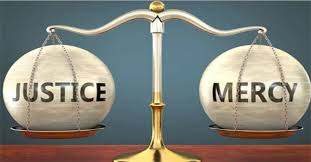
All these are examples of what I would say is Radical Mercy. Radical is defined as “relating to or affecting the fundamental nature of something; far-reaching or thorough.” In other words, going beyond what is expected. When there is justification for punishment or penalty. When society or the culture would support condemnation. In the sermon on the mount, Jesus gave us the beatitudes. But he also gave a series of statements generally beginning with “You have heard it said…..” He speaks of murder, of divorce, of taking oaths, adultery, and revenge. He takes what was then socially acceptable behavior, such as taking an eye for an eye, and raises the bar. He spoke of loving your enemy. Of lust being equivalent to adultery. Of speaking badly about another as being equivalent to murder. Of turning your cheek to someone who slaps you. To go the extra mile.
In the parable of the wheat and the weeds, the master tells his workers not to cut down the weeds now because they may also destroy the wheat crop. Instead he says to wait. To wait until the crop is ready to be harvested. When it will then be clear to the harvesters which is the wheat and which is the weeds. That job does not belong to us. We are here to make God’s word, God’s plan, know to all. It is his job to extract justice at the appropriate time. Our job? To reflect God’s Radical Mercy?
