When I was in Veterinary School, I had an ethics class. And in the class, one of the topics we discussed was the idea of what is a professional person. Why is one job called a profession and others are not. Typically the professions are those involved in medicine, law and engineering. There may be others but those are the ones to come to mind immdediatelly. And most of the students in the class agreed that these are professions. But I took umbrage with this concept. Why was it that certain occupations were elevated to an apparently higher level than others? After all, there are plenty of jobs that, if there were no one to perform them, we as a society would be in big trouble. What if no one were plumbers? How would we manage the water flow and security in our home. Same with electricians and carpenters. Don’t get me started on those who pick up our trash. We see what a mess we get in when sanitation workers go on strike. My point then, as it is now, is that we are all valuable in what we do as a job. And unless I am mistaken, pretty much all of these careers involve a salary. Not for free. So they are not amateurs at what they do and, thus, are instead professional.
Now here is the thing. I am sure we know individuals who work in one of the accepted careers that are deemed to be professions. And we know some that make sure that you know that they are, in fact, professionals. They strut their titles to you privately or in public so that others may hold them in higher esteem. Some physicians insist on being called Doctor, even in social situations. Some wear the titles as badges of honor. And on the flip side, I am sure we are familiar with those in these very same professions that, unless you knew them in the context of them performing their jobs, you would never know that they were a “professional”. They are just regular people who happen to have gone to school to learn the job they hold. So, the basis is not the stated job in terms of whether it is a profession or not. It is how the person holds himself up as a member of that particular career. It is about humility.
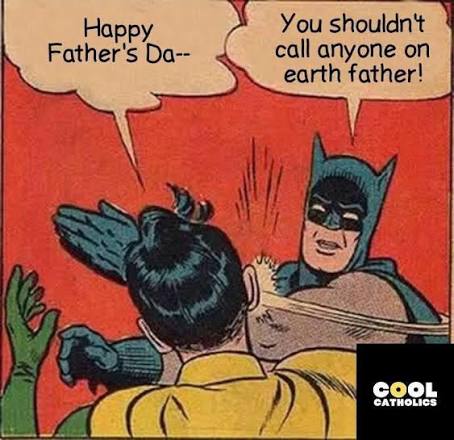
And this is where we see Jesus in today’s Gospel as he observes the ways of the Pharisees. He tells his Apostles to do as the Pharisees teach for they are excellent teachers of the law. But do not emulate what the DO. For the Pharisees like to use their positions as instruments of status in public. Making sure that the “lesser folks” call them “Rabbi” and they receive honored places at banquets. And He goes on to make this well know statement:
As for you, do not be called ‘Rabbi.’
You have but one teacher, and you are all brothers.
Call no one on earth your father;
you have but one Father in heaven.
Do not be called ‘Master’;
you have but one master, the Christ.
Catholics are often criticized for calling our priests Father since it appears Jesus is commanding us to not do so. But is He really? Remember that we call priests Father because He represents Christ and the Church is the bride of Christ. And Christ is our Father. And, as such, the priest stands in for Christ as our Spiritual Father. He has the responsibility for the soles of his congregation. His spiritual children. So does Jesus REALLY mean to call no one on earth Father? Well then, how do explain when Jesus says this:
For God said, ‘Honor your father and mother’ and ‘Anyone who curses their father or mother is to be put to death.’
And when St. Paul says to the Corinthians in 1 Corinthians 4:15:
, the Apostle Paul states: “For even if you had ten thousand others to teach you about Christ, you have only one father. For I became your father in Christ Jesus when I preached the Good News to you”.
So clearly, Jesus is not asking us to refrain from calling your Father, and by extension priests as spiritual Fathers, by the name “Father”. In the same verse where he says not to call any man on earth Father, he also includes the term Rabbi or Master. No one is then criticizing Jews for using the term Rabbi as they do for calling Priests, Father. And maybe we should no longer be awarding Masters Degrees. So what is Jesus really referring to in this passage from Matthew? To understand, you have to look at the whole reading. These commands by Jesus about parental and Rabbinic terms follows his observations about how the Pharisees conduct themselves. Like some who wear the badge “professional” on their sleeves so that they can gain notoriety in public, the Pharisees were often doing the same. They would use their positions to gain favor at parties, feasts, banquets and gatherings. They exaggerated the trappings of their vestments to be certain people were aware of their “superiority”. For many Pharisees their positions were more about status than teaching the law to their congregants. And that is the crux of Jesus’ message here in Matthew. The passage finishes with:
The greatest among you must be your servant.
Whoever exalts himself will be humbled;
but whoever humbles himself will be exalted.”
Jesus uses hyperbole, exaggeration, to get his point across. Do we really think that Jesus wanted us to hate our parents as He said in Luke 14:26? Of course not. He was making a point how His disciples needed to put Jesus first in all things in order to follow Him. And that is precisely what He is doing in Matthew when he says to call no man Father. He is warning His Apostles, and us, to put no man above following Him. And by wary of anyone touting themselves over the worship of God.
