I love bacon. I mean, who doesn’t? I even like reading about Sir Francis BACON! I am not sure I would trust anyone who doesn’t like bacon. The old saying goes, “what goes best with bacon? More bacon, of course!!” Now I am not talking about whether it is good for you or not. Just about the pure taste of bacon. And for bacon lovers there are only two types of people in the world. Those who like their bacon crisp and able to withstand the forces of gravity. And those, heaven forbid, who prefer their bacon cooked only to the point of flopping over and showing no backbone.
Why this diatribe on the virtues of the best part of a pig’s belly? Well, today is the feast day of the evangelist St. Mark and I learned something in our bulletin from St. Michael’s. On the feast day of St. Mark, Catholics are supposed to eat bacon. What?! I love bacon, as was made painfully obvious in the previous paragraph. But what does bacon have to do with the founder of the Church in Alexandria, Egypt? Well, legend has it that Mark’s relics were being kept in Alexandria and a group of Venetian merchants decided it would do well for the new church in Venice to have Mark’s relics there. The problem was that the port in Alexandria was controlled by Muslim officials and they were not too keen on the relics leaving the city. So, the merchants hid the relics in a barrel and covered them with pork. As we know, Muslims, like many Jews, eschew the eating of pork as commanded in the Old Testament (Leviticus 11:7-8). So when they saw all this pork they elected to allow the shipment to pass through the port without inspection. So the tradition of eating pork, especially bacon, on April 25th was born. Who knew? I for one do not need another excuse for eating bacon…but I’ll take it.
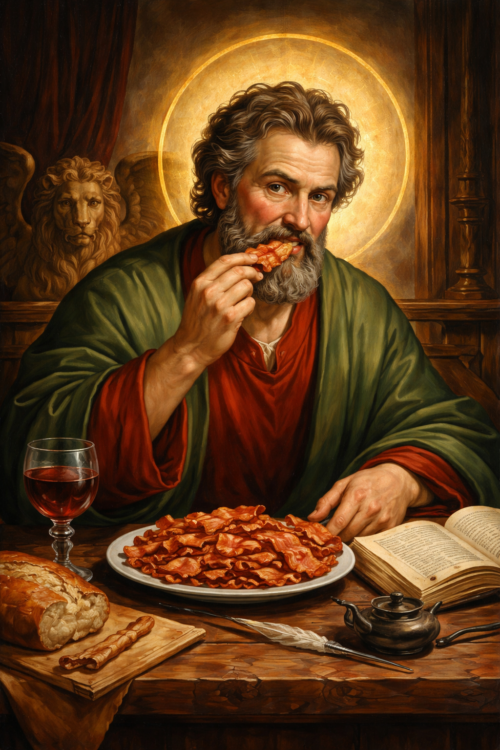
While the story of the smuggling of bacon is an entertaining one, worthy of a good Nancy Drew mystery, it points to a wider question in Church teaching. Why is it that Old Testament teaching on restrictions in dietary law no longer apply to Christians today? After all, we still abide by the Decalogue…the Ten Commandments. Why not the prohibition on eating pork? Some say Christians are guilty of cherry picking what laws from the OT they like and ignoring the ones they don’t like. First, let’s address the specific question of clean vs unclean foods. Jews today consider some foods to be kosher and some are non-kosher or “treif”. Key examples include pork, shellfish (shrimp, crab, lobster), meat mixed with dairy, non-slaughtered animals (carrion), and animals lacking cloven hooves and cud-chewing (e.g., rabbits, camels). Again, stemming from Leviticus. But Jesus said this in Mark 7:18-19:
“’Are you so dull?’ he asked. ‘Don’t you see that nothing that enters a person from the outside can defile them? For it doesn’t go into their heart but into their stomach, and then out of the body.’ (In saying this, Jesus declared all foods clean.)”.
And there is the well known story from the Acts of the Apostles where Peter has a dream where he sees forbidden foods being lowered from heaven on a sheet with Jesus telling him to eat. Thereby, declaring all foods to be clean. And we see another verse from Mark’s 5th chapter: where Jesus states:
“Not what goes into the mouth defiles a man; but what comes out of the mouth, this defiles a man.”
So the New Covenant, the New Testament, makes it clear that Jesus tells us that we no longer need to be concerned about what we eat but it is what comes from our hearts in how we treat each other and our relationship with His Father that is most important. But this does not just apply to dietary laws. All 613 of Moses Laws are called into question by Jesus. There are two basic types of laws found in the Mosaic Law. Most of the 613 are culturally based. Specific for the time in which they applied. Laws dealing with food, management, laws dealing with contagious diseases and legal matters. But the second type are called natural laws. Those that are characterized by moral principles and rights are inherent in human nature, universal, and discoverable through reason rather than created by society. Therefore, timeless. It are these laws that the Ten Commandments are based on and why they are pulled from the 613 laws and applicable today.
And when did these natural laws take effect? When the Old Law was fulfilled by Jesus. While Jesus was alive and walking amongst the people, he called the Mosaic Law into question with quotes like those mentioned above as well as the Beatitudes where He raised the bar instructing us to follow the spirit of the law…the natural law.. and not the legalistic basis. Jesus’ life represented a transition period between the Old and the New Covenants or Testaments. It was his final death and resurrection that brought all these things to fulfillment. And why we are no longer bound to cultural restrictions like the dietary prohibition on eating pork.
Now, where did Elise hide that pound of bacon I saw in the freezer yesterday?
