As I am writing this reflection, Elise and I are traveling from Pennsylvania to Illinois where my daughter and her family are waiting for us. The whole family, her, her husband, the twins and their eldest, are visiting the United States from Senegal, West Africa. They flew into Chicago where she has been showing her family where she grew up. After spending 10 days there with them we take the whole crew back to Pennsylvania for a few more weeks. Pretty exciting. First time her husband and the twins will have left the African Continent. Wish us luck and pray for us.
But that is not the point of the reflection. As I am writing this, I am a passenger in the car (obviously) and Elise is driving. This is a rental so we are both a bit unfamiliar with how the vehicle operates. Especially the electronics…but that is another topic for another day. I got to thinking about faith after going over today’s readings. Now faith can be an obscure concept. What does it exactly mean? Have faith. OK. Sounds good. I just might do that….but what is it? How about we answer that with some examples.
So Elise is driving on Interstate 80. We are surrounded by trucks, cars, constant construction zones and the ongoing sense of growing tired of being behind the wheel. There is a lot of faith going on. Faith that she will stay awake. Faith that she will not drift into another lane or fail to stop in time. Even more so, the faith that other drivers will abide by the rules of the road and not increase the threat of an accident. What this all comes down to is that faith is really TRUST. We place our trust in others that they will have everyone’s best interest at heart. That they will perform in a way that keeps us all safe.
There are many other areas of trust in our lives. We trust that the farmers who grow their crops will do so to prevent harmful contaminants from being present. That the food processors and handlers will do the same. That airplane mechanics will have done adequate maintenance for our flights and that the pilots will have gotten enough sleep and are not using alcohol or drugs. We have trust that parents will do all they can to raise their children in the best ways possible to be a valid member of society. Sometimes we trust that others can do what seems to be impossible. Surgeons performing life-saving procedures on conditions that seem hopeless. Architects, engineers and construction workers building bridges that span great chasms that support unbelievable weight and stress.
So faith at its core is trust. Trust that the word of another can be depended upon. Which brings us to Abraham, Sarah and the three strangers who visit them at their desert home. The couple welcome them as they are seemingly wandering in the middle of nowhere showing up on their tent-step. What they do not realize is that one of the three is the Lord. And He is there to give them a message. That by the same time next year, Sarah will have a son. Now remember at this point Abraham and Sarah, especially Sarah, have mostly lost hope in the promise God gave them that Abraham would be the Father of many nations. Sarah, we are told, is well past the point of being able to conceive. She has gone through menopause maybe 40 years earlier. She has convinced Abraham to lie with her servant Hagar and she conceived a son, Ishmael. A sure sign that Sarah no longer trusted in God’s promises. She took matters into her own hands not waiting for God’s promise to come to fruition.
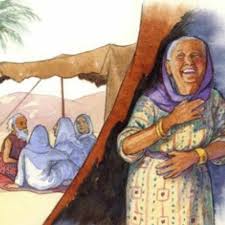
And how did Sarah respond to the revelation that she would conceive? She laughed. She thought she laughed quietly to herself and in secret. But God hears all and He accused Sarah of laughing, which she proceeded to deny and God reinforced. Do you recall the story of an angel appearing to Zechariah informing him the Elizabeth would conceive (with John the Baptist)? Zechariah’s response was also disbelief and denial that this was possible. For his doubting, he was struck dumb until after the birth of John.
And then there is the most famous annunciation story of them all. Gabriel telling Mary that she was to have a son, even though she had no relations with a man. Mary briefly questions the angel but quickly accepts the news and declares her obedience to the will of God. She does not laugh and she does not reject what seems utterly impossible. She displays TRUST…FAITH in God’s word and God’s promises.
From the trust of an old man in Abraham to the trust of a young virgin in Mary. Faith in God comes in many forms. Even a Roman Centurion trusts that Jesus will cure his servant. Or Peter’s Mother-in-Law believes, has faith in and trust in the works of Jesus.
Last weekend was the Feast of Corpus Christi…the Body of Christ. The feast was instituted by Pope Urban IV in order to re-emphasize Catholic belief in the real presence of Christ in the bread and wine. Belief in the doctrine of transubstantiation. In a 2019 Pew Research study, the survey found that 31% of persons who identify as Catholics believe in the Real Presence. The percentage increases among those who regularly attend Mass. Which means that a significant percentage of Catholics fail to have faith/trust in what the Church teaches on the Real Presence, which is based on Christ’s teachings. It is a core belief of Catholicism. I suspect that many of you are faced occasionally with trying to uphold the teaching on transubstantiation. So I would like to take a moment to give a few basic points that demonstrate what Christ was telling us in John Chapter 6, what Paul says in 1 Corinthians, Chapter 11 and what the Church Fathers said about the teaching:
- Christ said in John 6 to eat his body and drink his blood in order to achieve salvation 13 times in a span of 9 verses. He says this even as many of his disciples walk away in disbelief. He does not call them back to tell them He was speaking metaphorically.
- The word in Greek used for eat is more like the word for “chew” or “gnaw”
- Paul in 1 Corinthians speaks about receiving the body and blood unworthily. In a state of serious sin. He says that a person who is not in a state of grace when receiving Christ can face physical weakness, illness, or even death. Why would he say this if it was believed that the bread and wine were merely symbols of the body and blood?
- Why would so many of the apostles suffer death in adhering to the belief in Christ’s resurrection and in the belief that they receive Him in the Eucharist?
- And why would the Church Fathers such as Justin Martyr and St. Ignatius of Loyola write about the real presence in writings from the first and second centuries?
- And the many miracles where the host after consecration turned into heart muscle or oozed blood of the same blood type.
Did Mary trust that she, a Virgin, could conceive the Savior of the World? Did Abraham trust in the Lord’s promises that he would be the Father of many descendants even though he was past his prime. And did Elizabeth do the same when Zechariah was promised a son? Do we have the faith and the trust in Church teaching about the Real Presence even though it seems impossible? And can Elise get through just one more contraction zone unscathed. Stay tuned.
